Land Acknowledgement Resources
Publicly acknowledging the original stewards of the land you are on can be a meaningful way to honor indigenous peoples and resist erasure of their histories. The power of an acknowledgement lies in learning as much as you can about local treaties and practices, while working to build accountable relationships.
If you want to make a land acknowledgement but aren't sure where to start, here are some local, national, and international resources and examples:
Beyond Territorial Acknowledgements
U.S. Department of Arts and Culture: A Guide And Call To Acknowledgement
Teen Vogue: Indigenous Land Acknowledgement, Explained
If you want to make a land acknowledgement but aren't sure where to start, here are some local, national, and international resources and examples:
Beyond Territorial Acknowledgements
U.S. Department of Arts and Culture: A Guide And Call To Acknowledgement
Teen Vogue: Indigenous Land Acknowledgement, Explained
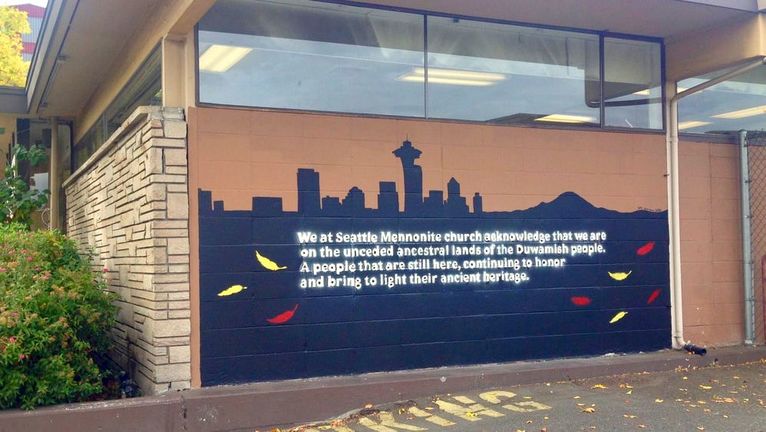
“We at Seattle Mennonite church acknowledge that we are on the unceded ancestral lands of the Duwamish people. A people that are still here, continuing to honor and bring to light their ancient heritage.”
Exterior wall of Seattle Mennonite Church in North Seattle. This was a project of a senior high school student who worked closely with a Duwamish elder.

"Northwest Film Forum acknowledges that we gather on Indigenous land: the traditional territory of Coast Salish peoples, specifically the Duwamish Tribe (Dkhw Duw’Absh)."
Interior wall of Northwest Film Forum in Capitol Hill neighborhood.